Ranz des Vaches
William TellRanz des Vaches is a recurring pastoral melody that gives the drama a recognizable sound across changing scenes. It is heard first in the opening landscape, sung in successive variations by figures associated with the lake and mountains, and sounded again on Alp-horns late in the play. Its recurrence links distinct voices and places without making it a spoken explanation: the music belongs to the world onstage, and its returns let that world be heard as well as seen.
Opening Soundscape
At the rise of the curtain, the melody and the tinkling of cattle bells continue for some time. The stage presents the peaks of the Hacken surrounded by clouds and glaciers in the distance. This pairing of music with visible mountain scenery establishes an acoustic as well as a visual setting before the dramatic exchanges take over. The melody is not introduced as an isolated musical flourish: the cattle bells sound alongside it, and its duration gives the audience time to register the pastoral scene.
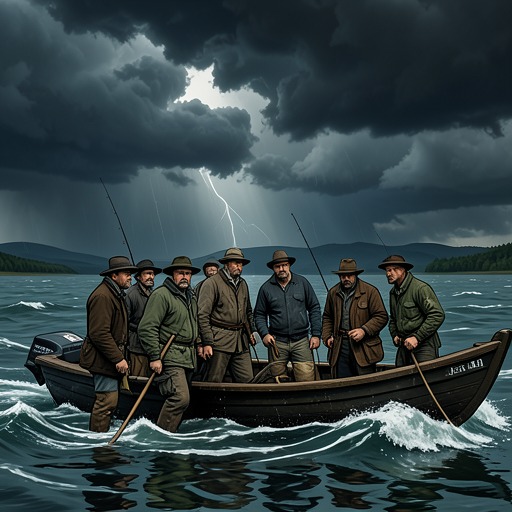
The fisher boy sings in his boat to the melody. The song’s imagery turns toward the lake, which is presented as inviting the listener to bathe in its depths. The singer’s position in a boat makes the song part of the displayed landscape rather than a disembodied accompaniment. Water, voice, and melody meet in the opening sequence, while the bells continue the sound of pastoral life around them.
Voices and Variations
The melody then passes from the fisher boy to a herdsman on the mountains. The stage direction identifies the herdsman’s tune as a variation of Ranz des Vaches, and his song takes leave of the green meadows as summer ends. The change in performer also changes the song’s immediate subject: the fisher boy’s stanza turns toward the lake, while the herdsman’s farewell marks a seasonal departure from the pastures. The shared melody holds these different images together while the voice and setting shift.
A chamois hunter appears on the top of a cliff and sings a second variation. His stanza invokes thunder on the heights and a trembling bridge. The sequence therefore moves from the lake to the mountain pastures and then to a high, exposed position associated with the hunter. The tune is named through these stage directions as a melody capable of variation, while the lyrics give each appearance a distinct landscape and circumstance. Its recurrence is not simply repetition: familiar music accommodates a new singer and a change in the scene’s focus.
A Melody Heard Beyond the Opening
Near the end, Ranz des Vaches is heard offstage, sounded on Alp-horns. The source has changed again: instead of a singer seen onstage, the music arrives from beyond the visible action through the horns. Hedwig hurries in immediately after the stage direction for the sound. The melody thus returns as an audible cue at a moment of movement, carrying the earlier pastoral sound into a later dramatic scene without repeating the opening arrangement of boat, bells, and visible singers.
Across its appearances, the melody connects a sequence of concrete sound events: cattle bells continuing after the curtain rises, a fisher boy singing from his boat, a herdsman’s variation, a chamois hunter’s second variation, and the offstage Alp-horns. Each setting gives it a different relation to the stage—part of the opening atmosphere, a vehicle for a character’s song, or a sound heard beyond the scene. That progression makes the melody more than a marker of pastoral scenery. It recurs in changed forms, allowing the play’s mountain world to persist as an audible presence even when the original singers and landscape are no longer in view.